Showing posts with label temperature. Show all posts

Wednesday, March 25, 2015

Determining Rayleigh Scatter Lidar Temperatures Using an Optimal Estimation Method

Middle atmosphere temperature profile retrieved using an OEM (red curve) compared to the traditional analysis using 2 detector channels (blue and green curves).
  • A lay summary of the paper is available at the Optical Society of America’s Spotlight on Optics.
We have recently published a paper in Applied Optics detailing a new method for retrieving temperature from Rayleigh lidar measurements using an optimal estimation method (OEM). The OEM allows a full systematic and random uncertainty budget to be done for each retrieval, specifies the height to which the retrieval is insensitive to the a priori temperature profile and gives the vertical resolution of the retrieval as a function of height. The ability to determine the full uncertainty budget is particularly important for using the Rayleigh-lidar temperature measurements for determining long-term changes, particularly for multi-instrument networks like NDACC or GRUAN. The method uses a free community-supported OEM solver developed by P. Eriksson and colleagues (qpack, part of the ARTS retrieval software package). 

We encourage you to try this method, and we are available to help answer your questions as you implement it. 

Bob and Alexander 


Friday, January 24, 2014

zing! xkcd: Cold

or should I say cold-#snap! xkcd: Cold

Nice to see something obvious so simply explained, though I fear it will miss its intended audience and just “preach to the choir”.

Sunday, September 23, 2012

Recollections of the ISSI Lidar Temperature and Ozone Algorithms Working Group: Meeting 3

Wow been just over a week since I left Switzerland after a (hard!) working group meeting on lidar temperature and ozone algorithms (part of the Network for Detection of Atmospheric Composition Change, NDACC, lidar group). The International Space Science Institute was very accommodating to us, the weather was too nice (hard to work indoors through much of the day) and the meeting extremely productive. The group (including NDACC lidar scientists not at this meeting) is working on various issues of our data analysis with the goal of further improving the uniformity of the global data sets available from the NDACC program. During the week we spent considerable time on several details, some of which seem at first to not be important to the problem at hand. For instance, using our temperature measurements in the middle and upper atmosphere to investigate atmospheric change requires a fairly precise knowledge of Earth’s gravity at the surface. So we have to expand our expertise beyond the atmosphere into other areas, which to me is a fun part of being a scientist.

Our working group leader Thierry had us marching along in tight formation all and we obediently followed (for a bunch of scientists).


We worked hard all day but enjoyed dining together in the evening.


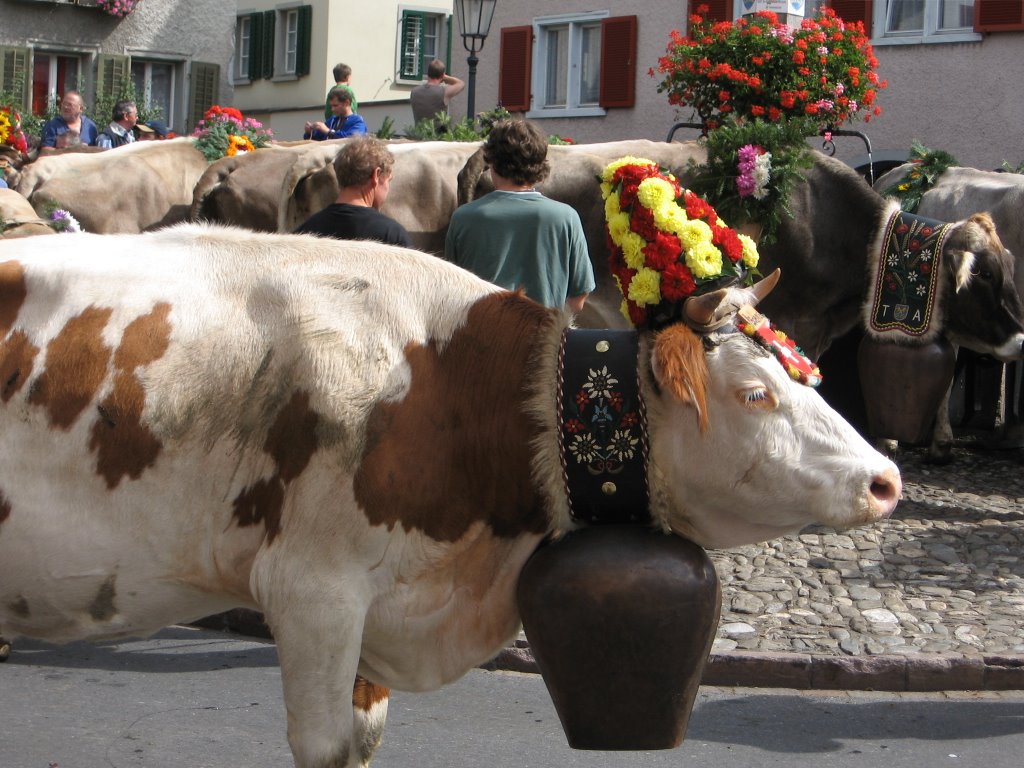
And not to worry! I got both a goat bell


and a cowbell (slightly smaller :-)


Pat and I have been happily clanging away all week. Here are a couple more pictures.